
Innovation through Intuition: The Trilogos Method at the Bildung Conference 2026
A joint research project exploring the role of intuition and dialogue in research and development (R&D) | FoU in April 2026
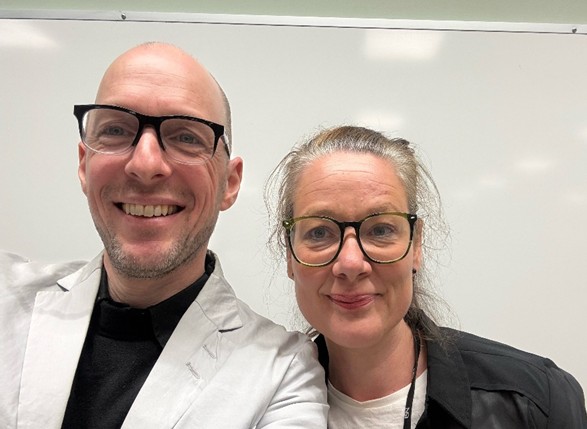
Source: ao.Prof. Camilla Angeltun und Prof. Michael Weiss
_____________________________________________________________________________
At the 2026 Bildung Conference “The Humanizing Power of Explorative Dialogue,” at USN Professor Michael Noah Weiss and Camilla Angeltun presented a joint research project exploring the role of intuition and dialogue in research and development (R&D).
Their presentation, “Innovation through Intuition – A Dialogical Action Research Project on the Trilogos Method as a Source of Inspiration in R&D Processes,” addressed a fundamental challenge: while R&D is central to both academia and professional practice, genuinely new and sustainable ideas rarely emerge from linear and purely instrumental thinking alone.
The project brought together researchers from the University of South-Eastern Norway and Université Paris Nanterre. Through a series of seven guided imageries based on the Trilogos Method—developed by Swiss educator L. V. Roethlisberger—the participants engaged in structured inner experiences followed by collective, explorative dialogue.
The Trilogos Method integrates rational, emotional, and spiritual dimensions of learning and reflection. While traditionally used for personal development and inner balance, this project also explored its potential in a new context: as a catalyst for innovation in academic R&D practice.
In a series of digital gatherings, participants shared their experiences from the guided imageries and reflected together on their relevance for their own research processes. These dialogues became spaces of shared meaning-making, where intuitive insights were articulated, questioned, and further developed collectively.
The findings suggest that innovation through intuition—understood as ideas emerging from the interplay between inner experience and dialogical exploration—can become a valuable and legitimate dimension of professional R&D work.
The presentation invited participants to reconsider the nature of knowledge development and to explore how dialogical, experience-based approaches may expand the horizons of both academic and professional practice.
Prof. Dr. Michael Weiss
